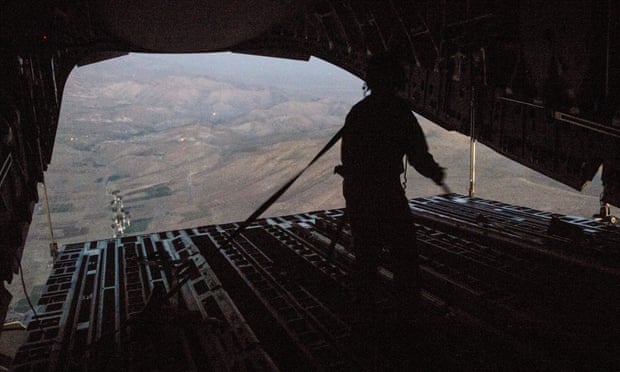
Nearly three years after Barack Obama withdrew the US military from its bloody, exhausting second conflict in Iraq, the first US service member has died there in the third US-Iraq war.
Marine Lance Corporal Sean P Neal, one of 1,600 troops serving in Iraq to support the Iraqi struggle against Islamic State (Isis),
died of a “non-combat” injury, the US announced late on Friday. Neal,
of Riverside, California, died in Baghdad, more than 7600 miles from his
home, on Thursday.
Neal, 19, was the first American acknowledged to have died in
Operation Inherent Resolve, the US military’s new name for the war Obama
launched on August 7. Americans have been dying in Iraq since 1991, some four years before Neal was born.
Technically, Neal may not have been the first US fatality of the
Iraq-Syria war against the Islamic State. Naval forces assigned to US
Central Command, which has operational control of the war, acknowledged
on October 3 that a Marine, Corporal Jordan L. Spears, went missing at
sea in the North Arabian Gulf after bailing out of his MV-22 Osprey.
Spears took off from the amphibious assault ship USS Makin Island, which
carried Marines of the 11th Marine Expeditionary Unit, assigned to
support the war in Iraq and Syria.
But Neal is the “first casualty announced by the Department since
Operation Inherent Resolve was announced,” said Maureen Schumann, a
spokeswoman for the Defense Department.
Neal was a mortarman with the 2nd Battalion, 7th Marine Regiment. He
was part of the special Marine air-ground task force that deployed to
Iraq around September, according to the 1 Marine Expeditionary Force
public affairs office. He had barely been in the Marines a year, having
enlisted on July 22, 2013.
The Marines said the circumstances surrounding Neal’s death were
under investigation. Marine Central Command did not immediately return
inquiries seeking additional comment about how Neal died or what
function he was performing in Iraq.
The second Iraq War, lasting from 2003 to 2011, claimed the lives of 4,487 American servicemembers.
In June, after Isis overran much of the Sunni areas of Iraq from its
base in eastern Syria, Obama ordered US troops back into Iraq,
officially in a “non-combat” role. Troops based in Baghdad and Erbil
have supported and advised Iraqi and Kurdish forces on their
counteroffensives. On August 8, US airstrikes against Isis targets
began, a mission that has spread into attacking Isis training
facilities, barracks, positions and vehicles in Syria.
With Obama ruling out US ground combat, US military planners
acknowledge that they will not have a reliable, capable ground force to
take territory from Isis in either country for months at least. Iraqi units, described by commanding general Lloyd Austin as the centerpiece of the war for the moment, are not ready to wrest Mosul or other significant territory from Isis . Across the border, the US has yet to begin vetting Syrian rebels for training as a proxy force,
a process expected to take the better part of a year for an initial
strength of 5000 fighters, against as many as 31,000 Isis militants. It
is unknown if the vetting effort even has a US officer assigned to it
yet.
Despite Austin’s stated prioritization of Iraq, US airstrikes have
most heavily targeted Isis near the Syrian border with Turkey, to
relieve the Isis assault on Kobani. Meanwhile, Isis is reportedly
consolidating and expanding its hold over Iraq’s Anbar province, west of
Baghdad. US military officials have said in recent days they do not see
a significant Isis threat to Baghdad, the site of Neal’s death.
On Friday, combatting a swell of criticism about the conduct of the
war, the Pentagon spokesman, Rear Admiral John Kirby, told reporters
patience was necessary.
“We believe the strategy is working; that the policy is sound, the
coalition continues to gain both momentum and strength,” Kirby said.
The first US service member has died in the third US-Iraq war, although not in combat, the Department of Defense says


